
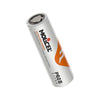
18650 vs 21700 Batteries: Key Differences and Why Pack Builders Are Choosing 21700
by 18650 Partners, 5 min reading time
by 18650 Partners, 5 min reading time
18650 or 21700? Compare size, capacity, current and cost per watt-hour, and see why most battery pack builders now choose 21700 cells for e-bikes, drones and power tools.
The 18650 has been the workhorse of lithium-ion packs for decades. The 21700 is its bigger, newer sibling, and it is quickly becoming the default for new pack builds. This guide explains what actually separates the two formats, where each one still makes sense, and why most builders starting a new e-bike, scooter, drone or power-tool pack today reach for 21700 cells.
Cylindrical lithium-ion cells are named after their size. The first two digits are the diameter in millimeters and the last digits are the length (the trailing "0" means it is a cylinder).
Both use the same lithium-ion chemistry families and the same voltage window: about 3.6–3.7 V nominal, 4.2 V fully charged, and a typical discharge cutoff of 2.5 V. They can be charged with the same CC/CV chargers, as long as the charger's bay physically fits the larger 21700.
| Spec | 18650 | 21700 |
|---|---|---|
| Size | 18 × 65 mm | 21 × 70 mm |
| Internal volume | About 16.5 cm³ | About 24 cm³ (roughly 45–50% more) |
| Typical weight | 45–48 g | 65–70 g |
| Typical capacity | 2,500–3,500 mAh | 4,000–6,000 mAh |
| Typical continuous discharge | 10–35 A | 10–45 A (some high-power cells rate higher) |
| Energy per cell (approx.) | 9–12.5 Wh | 14.5–21.5 Wh |
| Nominal voltage | 3.6–3.7 V | 3.6–3.7 V |
Exact figures vary by model, so always check the manufacturer's datasheet for the specific cell you are using.
Every cell is a compromise between capacity (mAh, how long it runs) and power (continuous amps, how hard it can be pushed). That holds true in both formats:
The key point: because the 21700 has so much more room inside, it can offer more capacity at the same current rating, or more current at the same capacity, than an 18650.
Take a 48 V (13S) e-bike pack targeting about 20 Ah. With 3,500 mAh 18650s you need 13S6P = 78 cells. With 5,000 mAh 21700s you need 13S4P = 52 cells. That is 26 fewer cells to buy, test, match, and weld.
Every cell has two terminals, and every terminal is a spot weld that can fail. Cutting the cell count by a third cuts the welds, nickel strip, and fish-paper insulators by about a third too. Fewer connections means fewer failure points and faster builds.
Per cell, a 21700 costs a bit more than an 18650. Per watt-hour of finished pack, it usually comes out equal or cheaper, especially once you add in the labor, nickel, and holders that you no longer need.
Larger cells can deliver higher continuous current with less voltage sag and less heat per amp. That gives builders more headroom for hill climbs, hard acceleration, and drone punch-outs without pushing cells to their limits.
EV makers popularized the 21700 format in the late 2010s, which pushed cell makers like Samsung SDI, Molicel, LG, and Panasonic to put their newest chemistries into 21700 cans first. Many of the most advanced cells on the market today are only offered as 21700s.
The 18650 is far from obsolete. Builders still pick it when:
For new builds, the 21700 wins on cell count, assembly time, cost per watt-hour, and current headroom, which is why most pack builders have made the switch. The 18650 remains the right answer when the space, the existing pack, or the device dictates it. Whichever you choose, buy genuine cells from a trusted supplier, match them carefully, and never mix formats, models, or ages in the same pack.
Shop genuine 18650 and 21700 cells


